Yellow Filters for B&W Photography
Why a Yellow Filter?
If a red filter is a sledgehammer, a yellow filter is a chisel.
The Yellow 8 (also known as the K2, Wratten 8, or Hoya Y2) is the single most recommended filter for black and white film photography. Many photographers leave one on permanently because panchromatic B&W film is more sensitive to blue light than the human eye. Without a filter, blue skies render too light and clouds tend to wash out. A yellow filter corrects this, producing tones closer to what you actually see when you look at a scene.
If you’re new to the visible spectrum or want a refresher on what “yellow light” actually means, have a play with the slider below:
Yellow light lives in the middle of the spectrum, roughly 570 to 590nm. A yellow filter passes this region and everything above it (orange, red) while absorbing shorter wavelengths (blue and violet). The result is subtle but meaningful: blues darken, warm tones stay put, and your images gain a gentle contrast lift.
Our simulator includes a full collection of yellow filters, from the barely-there Pale Yellow 2A all the way to the Yellow-Orange 16. This guide focuses on the three most useful: the Yellow 8, Deep Yellow 12, and Deep Yellow 15.
Our Reference Photo
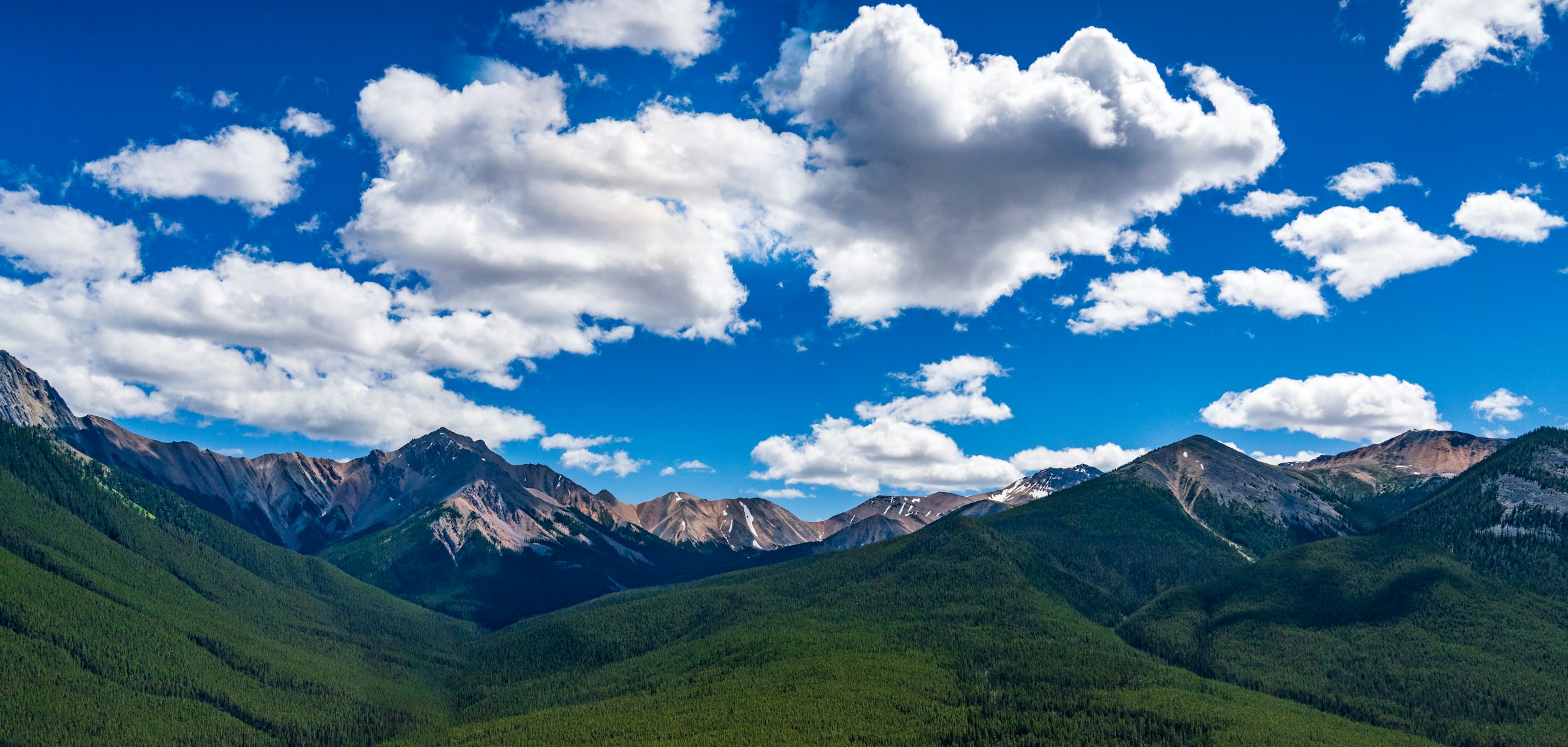
To show you exactly what a yellow filter does, we chose a scene that plays to its strengths. This panoramic mountain landscape has everything a yellow filter loves: a wide blue sky packed with textured clouds, dense coniferous forests across the slopes, and distant peaks fading into atmospheric haze.
Photo by Kai Gradert on Unsplash
Without a filter, the blue sky would wash out to a pale grey in B&W and those gorgeous clouds would disappear. The haze on the distant peaks would flatten the sense of depth. A yellow filter corrects all of this with a light touch.
How Yellow Filters Change Contrast on Film
On black and white film, every colour in the scene becomes a shade of grey. The problem is that panchromatic film treats blue and violet as brighter than your eyes do. This is why unfiltered B&W photos often have pale, washed-out skies. A yellow filter fixes this by blocking blue light before it reaches the emulsion.
Here’s what changes:
- Blue objects (sky, water, shadows) receive less light and appear slightly darker
- Green foliage lightens gently, revealing more texture in leaves and grass
- Red and warm tones (skin, brick, autumn leaves) stay roughly the same or lighten slightly
- Clouds stay bright while the sky behind them darkens, creating natural separation
The key word there is “slightly.” Unlike a red filter that turns skies near-black, a yellow filter makes a correction. It brings sky tones back to where your eyes expected them to be.
Here’s our reference landscape with a Yellow 8 filter applied. The left shows the filtered result, the right shows unfiltered B&W. Look closely at the sky: the difference is subtle, and that is exactly the point.
Click or tap anywhere on the image to move the split and compare different areas of the scene.
The sky has darkened from a pale, washed-out grey to a natural mid-tone, and the clouds now pop with real definition. The forested slopes have gained subtle texture, and the distant peaks cut through the haze more clearly. It’s not a dramatic transformation. That’s the whole point. The Yellow 8 is a correction filter, not an effects filter. Its job is to make the scene look right, not to make it look different.
Natural Skies: The Classic Yellow Filter Look
This is why most B&W film photographers own a yellow filter. A blue sky that would print as a pale, flat grey without any filter becomes a natural-looking mid-grey with a Yellow 8. Clouds that were barely visible on the unfiltered negative now show real definition.
The result doesn’t scream “filtered.” It looks like what you saw when you pressed the shutter. That’s the magic of the Yellow 8: it doesn’t add drama, it removes a problem. Panchromatic film’s over-sensitivity to blue is a technical quirk, and the yellow filter quietly corrects for it.
This is also why you’ll hear photographers say they “leave a K2 on all the time.” The effect is subtle enough for every single frame, the exposure cost is just 1 stop, and TTL metering handles it automatically.
What About Yellow-Green Filters?
The yellow-green filter (Wratten 11, sometimes called X1) is a hybrid that sits between yellow and green filters. It darkens blue skies like a yellow filter while also brightening green foliage like a green filter. The result is a balanced rendering that works particularly well in landscape scenes loaded with vegetation.
Where a pure yellow filter treats greens as neutral, a yellow-green filter actively separates different shades of green. Dark pines, bright meadow grass, and olive-tinted shrubs all render as distinct tones rather than merging into the same grey. If your landscape work involves a lot of forest or garden photography, this is worth knowing about.
Yellow-green filters need about 2 stops of exposure compensation (filter factor 4x), making them less convenient for leave-it-on use than a Yellow 8. They’re more of a situational tool.
Beyond Skies
Yellow filters aren’t just for landscapes. Here are some other situations where they shine:
Street Photography
The Yellow 8 is popular in street photography because it adds gentle contrast without looking heavy-handed. Skies darken slightly, buildings gain a bit of definition, and the overall image has more depth. Since the exposure cost is just 1 stop and the effect is never overpowering, many street shooters treat it as a permanent lens accessory.
Portraits
Yellow filters produce warm, natural-looking skin tones in black and white. They gently lighten red and warm tones in the skin, which can smooth out blemishes and produce a softer look. The effect is more subtle than a red filter (which can lighten skin dramatically). For medium and darker skin tones, the effect is gentler still.
Haze and Atmosphere
Atmospheric haze scatters blue light more than other wavelengths. A yellow filter absorbs that scattered blue, effectively clearing the view. If your distant mountains or cityscapes look washed out, even a Yellow 8 will bring back some definition. A Deep Yellow 15 cuts through haze even more aggressively.
Overcast Days
This is a significant advantage over red filters. On an overcast day there’s no blue sky to darken, so a red filter just costs you 3 stops of light for very little benefit. A yellow filter, on the other hand, still adds a gentle contrast boost by absorbing the blue component of the flat, grey light. It’s one of the few contrast filters that works well in any weather.
Choosing Your Yellow Filter: 8 vs 12 vs 15
Not all yellow filters are equal. There are three Wratten numbers worth knowing:
Yellow 8 (K2) is the classic all-rounder. It blocks some blue and violet light, giving you a gentle correction that suits almost every subject. If you only buy one filter for B&W film, this is the one. Filter factor: approximately 2x (1 stop).
Deep Yellow 12 is sometimes called the “minus blue” filter because it blocks nearly all blue light below about 500nm. The sky darkening is noticeably stronger than the Yellow 8, and the contrast increase is more pronounced. It’s a good stepping-stone if the 8 isn’t quite enough but you don’t want to jump to an orange filter. Filter factor: approximately 2.5x (1.3 stops).
Deep Yellow 15 is the strongest yellow filter. It transmits light above about 520nm, producing sky darkening and contrast that approach an orange filter. Green foliage still renders lighter than it would with an orange, making it a good choice when you want dramatic skies without losing detail in vegetation. Filter factor: approximately 3x (1.6 stops).
The chart below compares their spectral transmission curves. You can see how each successive filter cuts deeper into the blue end of the spectrum:
Based on spectral data and a generalised sensor model. Results approximate real-world behaviour.
Our simulator includes the full yellow family (from Pale Yellow 2A through Yellow-Orange 16) if you want to explore the subtle differences between them all. Upload your own photos to see how each one would affect your work.
Exposure Compensation
Yellow filters block less light than red or orange filters, making them very practical for everyday shooting.
A Yellow 8 needs about 1 stop of extra exposure. In practical terms: if your unfiltered reading is 1/250 at f/8, with a Yellow 8 you’d shoot at 1/125 at f/8. That’s barely noticeable. If your camera meters through the lens (TTL), it compensates automatically.
The Deep Yellow 12 and 15 need slightly more, but nothing dramatic. Use the calculator below to see the exact filter factors and stops for each:
Based on spectral data and a generalised sensor model. Results approximate real-world behaviour.
Yellow vs Orange vs Red: Where Does It Fit?
The contrast filter family follows a clear progression. Yellow provides the gentlest correction, orange gives you moderate enhancement, and red delivers full drama. Each step up blocks more blue and green light, producing progressively stronger contrast.
Here’s how a Yellow 8, Orange 21, and Red 25 compare in terms of spectral transmission:
Based on spectral data and a generalised sensor model. Results approximate real-world behaviour.
Yellow (8) lets most of the spectrum through and only trims the blue end. Orange (21) goes deeper, blocking blue and cutting into green. Red (25) blocks almost everything below 600nm.
For most B&W film photography, the yellow filter is where you start. If you find yourself wanting more contrast in specific situations, try the orange. If you want maximum impact, reach for the red. You can read our full guide to red filters for black and white photography for the dramatic end of the spectrum.
And here’s what the Deep Yellow 15 looks like on our reference landscape. Compare this with the Yellow 8 result from earlier:
The sky is noticeably darker than with the Yellow 8, the clouds really stand out, and the haze on the distant peaks has cleared further. However, it still feels natural compared to a red filter’s dramatic intensity.
Tips for Getting Started
Best subjects: Landscapes with blue sky and clouds, street scenes in daylight, portraits in natural light, hazy distant views, and any scene where foliage plays a prominent role.
Works in any weather: Unlike red filters, yellow filters add value on overcast days too. If you’re shooting B&W film regularly, a Yellow 8 earns its place on the lens in almost every condition.
Leave it on: Many film photographers treat a Yellow 8 as permanent glass. The 1-stop cost is low, the correction is always beneficial, and you can always remove it when you want a specific unfiltered look.
Bracket when learning: Shoot one frame with the filter, one without. Comparing the negatives side by side teaches you more about the filter’s effect than any article can.
Try before you buy: Upload your own photos to our filter simulator and see how each yellow filter would affect your style of photography. It’s the fastest way to build an intuition for what each filter does.
What’s Next?
A yellow filter is the foundation of B&W contrast control. It fixes the most common problem (pale skies), adds gentle depth to every scene, and costs almost nothing in terms of exposure.
If you want to understand the science behind how these filters work at a deeper level, check out our guide to understanding spectral transmission curves. If you’re ready to step up the contrast, our orange filters guide covers the middle ground, and our red filters guide covers the dramatic end of the spectrum. For an overview of all contrast filter families, see our complete guide to colour filters for B&W photography.
Frequently Asked Questions
What does a yellow filter do in black and white photography?
A yellow filter absorbs blue light and passes yellow, green, orange, and red. In black and white, this slightly darkens blue skies and water while keeping warm tones and foliage natural. The effect is corrective rather than dramatic, bringing the tonal rendering closer to how you actually see the scene.
What is the yellow-green filter in black and white photography?
The yellow-green filter (Wratten 11, also called X1) sits between pure yellow and green filters. It darkens blue skies like a yellow filter while also brightening green foliage like a green filter. It is particularly useful for landscape scenes with lots of vegetation where you want both effects at once.
How many stops does a yellow filter need?
A Yellow 8 (K2) has a filter factor of about 2x, which is 1 stop of exposure compensation. A Deep Yellow 12 needs about 1.3 stops, and a Deep Yellow 15 needs about 1.6 stops. These are small enough that through-the-lens metering handles them automatically.
What is the difference between a Yellow 8, Deep Yellow 12, and Deep Yellow 15?
The Yellow 8 is the gentlest, providing subtle correction that most photographers consider the default for B&W film. The Deep Yellow 12 blocks more blue light for stronger sky darkening and is sometimes called the minus blue filter. The Deep Yellow 15 is the strongest yellow, producing contrast that approaches what you get from an orange filter.
Can I leave a yellow filter on my lens all the time?
Yes. Many film photographers treat a Yellow 8 as a permanent fixture on the lens. The 1-stop exposure cost is negligible, and it corrects for the fact that panchromatic film is overly sensitive to blue light. The result is a more natural tonal rendering on every frame.
When should I use a yellow filter instead of a red or orange filter?
Use yellow when you want natural-looking tonal correction without heavy drama. Yellow filters work well in any lighting, including overcast skies. Red filters need blue sky to be effective and produce very strong contrast that can be too aggressive for everyday shooting. Orange sits between the two.